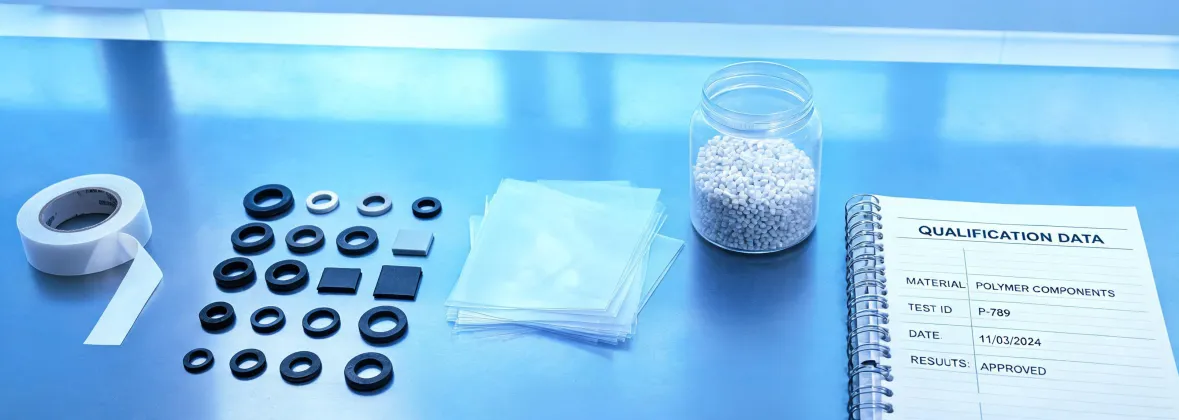
For seven years, I've managed procurement at a 47-person marine fabrication and vehicle graphics company. Our materials budget runs about $220,000 a year. I've compared quotes, watched installations, and logged failures. If someone asks me about rubber vs polyurethane bushings, my honest answer starts here: Neither rubber nor polyurethane is automatically better. The lower total cost depends on installed labor, service life, access, and the driver's tolerance for noise.
That conclusion did not start as a materials theory. It started with replacement bills. And over time, the same logic changed how I buy products I once dismissed as overpriced: 3M marine filler, die cut vinyl decals 3M exterior grade for cars, silicone labels, and Teflon foam.
Rubber vs polyurethane bushings: The part price is almost irrelevant
Bushings are a classic case of looking at the wrong number. Rubber bushings are cheaper, softer, and quieter. They absorb vibration and feel comfortable. They also wear faster in dirty or high-load service. Polyurethane bushings are stiffer, more expensive, and better at resisting oil, abrasion, and repeated loads. They transmit more noise and ride harshness. If you compare unit prices, rubber looks sensible. If you compare replacement cycles, polyurethane can be the cheaper product.
In our shop, a bushing replacement rarely costs only the bushing. The control arm may have to be removed, the suspension realigned, or the component cleaned before a press can be used. When shop labor runs $90 to $120 an hour, the bushing itself can be 5 percent or less of the total repair invoice.
We saw this first hand in 2024 on a fleet of eight box trucks. Four kept standard rubber bushings; four got polyurethane. The rubber trucks came back around the 47,000-mile mark with loose handling and creaks. The polyurethane trucks were still tight well past 90,000 miles. But the tradeoff was real: two drivers complained about the hard ride. We ended up with polyurethane on the rough-service trucks and rubber on the daily-driver trucks. That's not a brand preference. It's a total cost decision.
If you put the real factors into a simple math problem, it looks like this: material price plus labor to install plus labor to replace plus downtime plus warranty risk. A $15 rubber bushing that needs replacement twice as often is not automatically cheaper than a $45 polyurethane bushing—especially when every replacement means a flatbed or a customer service call.
The same logic shows up in filler, vehicle graphics, labels, and foam
Once I started thinking this way, I stopped classifying products as expensive or cheap. I started asking what happens when the product fails. That changed four material decisions in particular.
3M marine filler. I used to choose a generic polyester filler because the price per gallon was lower. The price on a repair quote, though, is mostly labor. In a cool, damp shop, cheap filler can cure unevenly. It sands like it's dry in some spots and soft in others. You end up recoating, sanding again, or explaining a wavy surface. When I checked our work order codes, repairs using 3M marine filler had a lower rework rate than the ones using commodity filler. I don't have hard data on how every brand behaves in every climate; I have our coastal shop's repair log. The surprise wasn't the premium price. It was the reduction in unpaid rework.
Die cut vinyl decals 3M exterior grade for cars. Vehicle graphics look identical on day one whether you use premium material or bargain film. After a year in the sun, bargain film can shrink, crack, and leave adhesive on the paint. The cost is not just the replacement vinyl—it's the labor to remove the old graphics, the risk of paint damage, and the time the vehicle is out of service. We now order die cut vinyl decals 3M exterior grade for cars for fleet graphics. The material cost went up modestly, but removal time went down. On a 15-vehicle re-branding job, that difference was significant.
Silicone labels. This one seems like an easy place to save money. Silicone labels cost more than ordinary polyester or vinyl labels. In a normal warehouse environment, a cheap label is fine. But when the product goes through high-heat washdowns or sees constant moisture, an adhesive label can curl, discolor, or fall off. The label fails, and the customer does not call it a label problem; they call it a product defect. A service visit to fix it costs far more than any label savings. We switched to silicone labels for that application and stopped seeing the failure mode.
Teflon foam. Comparing Teflon foam with EVA or rubber foam makes no sense if you only look at cost per square foot. Teflon foam, or PTFE foam, exists for low friction, chemical resistance, and stable performance in demanding seals and wear pads. We put it in a sliding cover assembly that gets wet and gritty. The previous rubber foam wore out twice in one year. The Teflon foam is still in service after two years. The upfront cost was higher, but the replacement labor and downtime were higher than the foam price in both directions.
When I still order the cheap stuff
I don't want this article to sound like a license to buy premium everything. There are situations where the cheaper option is the correct business decision.
If the part is easy to reach, easy to replace, and unlikely to damage anything else, a lower-cost bushing or material is fine. If the vehicle will be sold before bushing wear becomes a problem, rubber is reasonable. If the graphics only need to last for a one-time event or a short-term promotion, less expensive film can do the job. If a label is going into a dry indoor product with a short warranty period, ordinary label stock is probably enough. If you need a cushioning pad under a wear-free cover, skip the Teflon foam and buy the cheaper foam. The key is matching the material to the actual failure cost, not to the price list.
What I still can't tell you
I wish I had tracked every removal hour in our first two years of vehicle graphics work more carefully. What I can say from the records we do have is that the switch to 3M exterior film cut re-graphic labor by roughly one third. I don't know how that number transfers to a shop with different substrates, weather, or labor rates.
Another honest limitation: we didn't have a formal failure-tracking process when I started. The first couple of times a product failed, we blamed the material and bought something more expensive. Sometimes the real cause was surface prep or process error. The third time, I set up a simple rework code in our order system. That small change taught me more about purchasing than any vendor presentation.
So if you're comparing rubber vs polyurethane bushings, don't ask which is fundamentally better. Ask which is cheaper per failure, per mile, per year, and per customer complaint. That's the metric that pays for the parts.