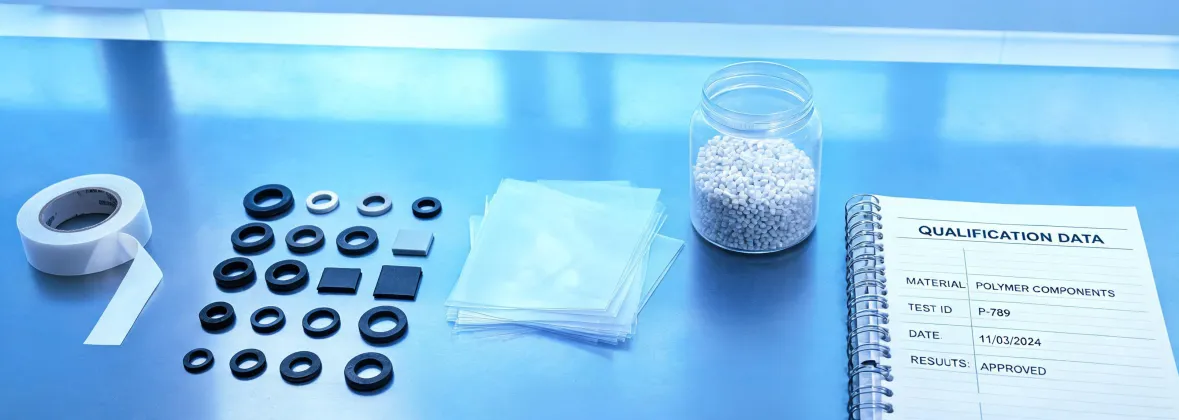
Every purchasing department has an email that makes the team groan. Usually it sounds like this:
“Just get the 3M stuff.”
I’m the office administrator for a 92-person manufacturing company. I manage material orders for maintenance, tooling, packaging, and production—roughly $430,000 a year across eight vendors. That phrase arrives more often than you’d think, usually followed by a product name that is supposed to make everything clear:
- “We need 3M plastic and emblem adhesive for the trim emblems.”
- “The truck project needs 3M cavity wax.”
- “We’re making silicone molds next week. Get resin material.”
- “Is neoprene rubber what we used on that gasket?”
They all sound like purchase orders. They’re all, actually, guesses.
I don’t say that to blame my coworkers. I blame the process—and myself—for letting requests like that go through without one clarifying question. It took two years, a few wasted orders, and one uncomfortable conversation with my VP before I fixed it.
The surface problem: names that sound like specifications
Here’s the thing. “3M plastic and emblem adhesive” is not a specification. It’s two material decisions taped together.
There is a plastic emblem, which could be cast acrylic, ABS, polycarbonate, or nylon. Then there’s an adhesive that must bond that specific plastic to a painted surface. If the plastic has low surface energy—polypropylene, for one—a standard adhesive won’t hold, and the emblem fails months later. Some plastics need a surface promoter. Some adhesives are liquid. Some are tapes. “Plastic and emblem adhesive” doesn’t tell you which. It tells me the requester remembers a product family, not the conditions the product has to survive.
“3M cavity wax” is similar. Cavity wax protects the inside of vehicle panels, but it isn’t one formula. There are aerosols, liquids, and solvent-based options with different flash points and application temperatures. I once ordered exactly what was asked and learned this only after the crew couldn’t use it for the spot it was meant to protect.
Even the simple question “is neoprene rubber what we used on that gasket?” isn’t simple. Neoprene is a synthetic rubber made from polychloroprene—not a plastic. It handles moderate oil exposure and weather well. But whether it suits a gasket depends on the fluid, temperature, pressure, and clamping design. The proper answer is “okay for what?”
The deeper problem: brand names are vocabulary shortcuts
Underneath all these requests is the same gap: a missing shared language for materials. Instead of naming a required property, people name a trusted brand or a broad category. “Resin material” becomes shorthand for anything that starts as a liquid and hardens. “Rubber” is treated as one material, even though different rubber families behave completely differently. “Plastic” is worse: it’s a universe, not a product.
When our product team said they were making silicone molds and needed “resin material by Friday,” I ordered clear polyurethane casting resin. It cures hard and strong—fine for rigid parts, useless for a flexible mold. They actually needed liquid silicone rubber to create the mold itself. First delivery was $190 down the drain, plus $218 in overnight freight for the correct material, plus four days of schedule slip before the prototype reached the client.
That mistake taught me a simple rule: “resin” isn’t a material. It’s a category—epoxy, polyurethane, polyester, silicone. Products in that category start as liquids and then go in completely different directions. The same rule applies to plastic sheet. Typing “3m plastic” into a search bar doesn’t tell a supplier whether you need PVC, PET, PS, ABS, or PP, or whether the board will be thermoformed, vacuum-formed, or die-cut. It doesn’t tell thickness, surface finish, required clarity, or impact strength.
I have mixed feelings about brand-name material requests now. Part of me gets it—when something isn’t your field, buying what you already trust is rational. Another part sees “the 3M stuff” as a sign that a decision is being skipped, not made. The fix isn’t to ban brand names. It’s to add the specification behind them.
What vague material requests actually cost
After the resin order, I started tracking replace-and-expedite situations. I don’t have hard data on industry-wide numbers, but in our own system, between March and September last year, 9 of 64 material orders needed a replacement or an expedite because the original request was ambiguous. Extra freight alone came to about $3,000. Unusable material added maybe another $1,500. That total doesn’t include the hours lost re-explaining projects or the uncomfortable moment when my VP asked why a “simple order” had turned into a delay.
There’s another cost that is harder to see. The lowest quote is only the lowest if the material actually does the job. During our vendor consolidation project in 2024, a supplier quoted $160 less on a sheet material because the requested category was vague. Another supplier asked what the sheet would be used for and how it would be processed. We went with the second one. That $160 “saving” would have turned into a much bigger problem if the material couldn’t form correctly the first time. In my experience, a wrong material’s hidden cost is almost always larger than the visible saving of a cheap one.
The fix wasn’t a new supplier. It was asking better questions.
We updated our internal material request form. Every order now answers five questions:
- What is the application? Name the end use, not the product name.
- What will the material contact? Heat, moisture, oils, chemicals, UV—list what it has to survive.
- How will it be processed? Thermoforming, vacuum forming, die cutting, bonding, or painting.
- What properties matter? Clarity, flexibility, hardness, thickness, dimensional stability.
- Is there a technical data sheet? If not, why not?
That last question is the most powerful. If a supplier says a plastic roll is “recyclable,” I ask where. Per the FTC Green Guides (ftc.gov), an unqualified recyclability claim should mean the product can be recycled in areas where at least 60 percent of consumers have access. If the supplier can’t say where, the claim isn’t substantiated—and I probably move on. We have to pass materials along to our own customers with confidence, so we need documentation.
For plastic sheet materials, the conversation now starts with polymer family: PVC, PET, PS, ABS, or PP. Then thickness, width, surface finish, and processing method. Brand and price come last, not first. And a vague phrase like “3M plastic and emblem adhesive” becomes a real spec: which plastic, which adhesive, and what surface preparation is needed.
My favorite question is still the simplest one: “What does this material have to do?” Most people actually know the answer. They’ve just never been asked.
These days, when someone says “just get the 3M stuff,” I ask them what the job is. Then we order the right material, once. That’s the cheapest thing I’ve learned in this role.