Last Tuesday, my first email of the morning had the subject line: "Order: 3m wood filler."
Two hundred tubes. Plus a bulk box of 3m nitrile gloves. This happens a few times a month — people find our website because we're 3m, lowercase m, and they assume we're that 3M.
I'm the quality compliance manager at a rigid plastic sheet manufacturer. That title sounds official until you realize it also means I handle the general inbox. Most of the time, I send a short reply: we don't make wood filler or gloves. We make PVC sheet and roll, PET sheet and roll, PS board, ABS sheet, PP board, and acrylic sheet for thermoforming, packaging, and industrial applications. Sometimes that ends the conversation.
But this email had a second paragraph. And that paragraph turned into one of the most useful material discussions I've had all year.
First, let's clear up the name
We've been 3m since 2009. People confuse us with the big 3M despite the lowercase m. We've received purchase orders for Scotch tape, respirators, and double-sided foam tape. Once, a PO for 80 boxes of Command hooks. I wrote back: "Wrong company, but I respect the hooks."
What most people don't realize is that name overlap like this is incredibly common in the plastics industry. There are dozens of small manufacturers whose names sit close to bigger brands. Buyers never notice until the invoice arrives.
Usually that's the end of it. But this particular email had a second paragraph.
The polycarbonate request
After the wood filler and glove request, the email continued:
"Also — do you stock polycarbonate sheet? We're setting up a new clamshell line for power tool packaging. The quote we have specifies polycarbonate profile extrusion for the rim. Can you supply?"
Straight answer: no. Polycarbonate isn't in our regular line. We know enough about it to know when it's the right material and when it's overkill.
So I asked the buyer — I'll call him Ken — the same four questions I ask before we approve a production run: What's the part and how is it formed? What will the finished product touch? What's the drop or impact requirement? What environment does it live in?
Ken's answers came back quickly. Clear lid so the tool is visible on the shelf. Needs to survive a 6-foot drop onto concrete, with the tool inside. Occasional motor oil and degreaser contact during shipping. Maximum storage temperature around 50°C.
Then came the kicker: "The spec we were quoted includes a polycarbonate urethane coating. The salesman said it's the standard for scratch resistance."
That was the moment I realized Ken had been handed a material system — polycarbonate sheet, polycarbonate profile extrusion, and a polycarbonate urethane topcoat — and had accepted it as settled fact. He'd taken the "polycarbonate lenses vs plastic" rule — polycarbonate is stronger, right? — and stretched it into a packaging decision it was never meant to support. If you've ever nodded along to a confident vendor's material recommendation without questioning it, you know exactly how he felt.
Why the polycarbonate spec didn't survive a closer look
I've spent 4 years reviewing production batches at a plastic sheet manufacturer. Roughly 800 rolls a year, checking thickness to ±0.02 mm and surface haze to a clarity standard. In 2024, I rejected 6% of first production runs. I do that because a spec is a promise. The one time we let a borderline batch through to satisfy an impatient customer, 8,000 units came back with stress cracks. That was a $22,000 lesson.
So I examined Ken's spec the way I'd examine a batch about to ship. It fell apart in three places.
1. The impact requirement didn't call for polycarbonate. Polycarbonate is brilliant at absorbing impact. That's why it dominates safety eyewear — the "polycarbonate lenses vs plastic" comparison exists because polycarbonate handles a hard impact without shattering. But a clamshell package distributes drop force through its geometry, the tool inside, and the latch. The hinge is the weak point, not the sheet. You don't need aerospace-grade toughness to survive a retail shelf. You need a material that won't stress-crack after fifty openings.
2. The chemical reality pointed the other way. Here's the part that surprises people: polycarbonate and oil don't get along. Motor oil, degreasers, and certain solvents can stress-crack polycarbonate and cloud the surface. That's why Ken's vendor included the polycarbonate urethane coating in the first place — it's a barrier for a known weakness. PET, on the other hand, handles oil and mild chemicals without needing a rescue layer.
3. The tooling drove the spec, not the product. I asked how the lid was designed. Turns out Ken's preferred supplier already ran polycarbonate profile extrusion for other customers. They had dies. They knew how to run PC. Quoting polycarbonate meant using paid-for tooling. But Ken's product didn't need a profile extrusion at all — a single thermoformed sheet of the right material would do the job.
That's the part nobody told Ken. In hindsight, I should have asked for the vendor's itemized quote on day one. The tooling setup fees would have been right there in the line items. Instead, we spent a week trading emails about material properties.
The fundamentals of clamshell packaging haven't changed in decades. The materials and coatings have. What was best practice in 2020 isn't necessarily best practice in 2025, and a modern hardcoated PET can deliver clarity and scratch performance that would have required polycarbonate only a decade ago.
The samples that changed his mind
I didn't argue with Ken over email. I sent him samples.
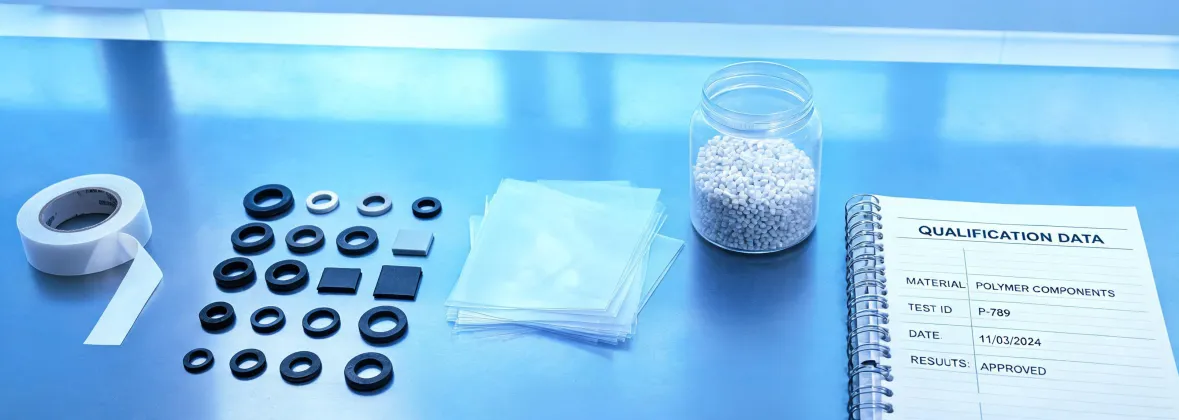
Four pieces, about A5 in size: high-clarity PET with our silicate hardcoat. Clear PVC. ABS for comparison. And one sheet of standard polycarbonate as a reference, labeled simply "PC."
I told him to put a drop of motor oil on each piece, leave it overnight, wipe it off, then try to scratch it with a key.
He called on a Thursday. "Sample A won. Nobody on the line could tell it from the PC until they picked it up."
The lightness gave it away. PET is roughly 9% less dense than polycarbonate. On a 250,000-unit annual order, that difference adds up in freight cost and material weight.
Ken switched the whole container to PET. Single thermoformed sheet. No separate rim extrusion. No polycarbonate urethane layer. His finished part cost dropped around 18%. I'd estimated 22% at the start, but the trim precision and tooling adjustments landed us at 18 — I'd need to pull the final job costing to give you the exact number, but that's close enough.
For the record: we ran a blind comparison with our own engineers during the Q1 2024 quality audit, hardcoated PET versus coated polycarbonate. 70% picked the PET as "more professional" without knowing which was which. The cost difference only made it easier.
What I'd tell any buyer specifying a clear plastic part
Ken re-ordered the same PET spec two months later, and converted a second product within the quarter. Rejects stayed flat. Material cost went down. That's what every quality person hopes for: better part, lower cost, no drama.
The lesson isn't "polycarbonate is bad." It's not. Polycarbonate is right for lenses, safety shields, machine guards, and structural glazing. Polycarbonate profile extrusion is a legitimate process when you need rigidity plus transparency. But neither is the right answer for a retail clamshell that touches oil and never takes a real impact.
The lesson is: revisit your specifications. Don't copy last year's bill of materials on autopilot. And here's something vendors won't tell you: polycarbonate carries a premium. It's a higher-margin sale. If they can quote polycarbonate, they often will — whether the part needs it or not.
Three things I now tell every customer who says "just match the old spec":
- Define the environment before you name the material. Temperature, chemicals, drop risk. Then pick a material to fit the environment.
- Test, don't assume. Ken's oil-and-key test took ten minutes. It taught him more than any datasheet.
- Compare total cost per finished part, not price per sheet. Polycarbonate was priced close to our PET with hardcoat — wait, no, I have that backwards. The PET with hardcoat was about 8% cheaper per sheet. Add the coating step and the profile extrusion on the PC side, and the per-part gap widened to 18%.
One more note for anyone in packaging: if your PET container is labeled "recyclable," make sure the claim holds where it's sold. Per FTC Green Guides, an unqualified recyclable claim should be valid in areas where at least 60% of consumers can actually recycle that material. It's a useful claim — just don't get sloppy with it.
As for Ken? His latest email started with: "Do you carry PET in 0.5 mm for a different project…"
No wood filler. No nitrile gloves. Just a purchase order for the material that actually fit the job.