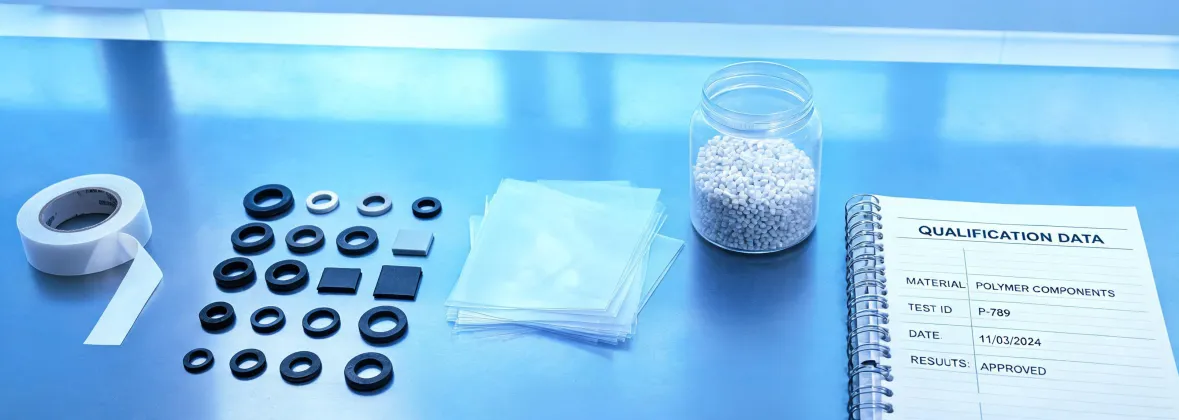
Ever typed 'silicone foam 3M tape supplier' into Google and gotten fourteen different results? I'm not here to judge. I've typed worse. I work at a plastics sheet/roll plant, and after fifteen significant mistakes totaling roughly $12,000 in wasted budget, I now maintain the team's pre-order checklist. In my first year (2017), I approved a quote based on unit price and ignored everything else. I still remember that invoice.
Our factory doesn't make tape, decals, or sealant. We supply PVC, PET, PS, ABS, PP, and acrylic sheets and rolls. But we get questions about these materials every week. Honestly, most buyers focus on a material name and completely miss adhesive type, liner, color tolerance, and compression behavior. There is no one-size-fits-all answer to material selection. It depends on where the part will live and what it has to survive.
So before you read on, identify which bucket you're in:
- You need silicone foam tape for sealing or gasketing.
- You need die-cut vinyl decals for a car, 3M exterior grade.
- You asked for 'Teflon sealant' for a threaded connection.
- You're trying to figure out whether TPU is rubber, or what 'live+resin' means.
Each one has different rules. Let's get into it.
Scenario 1: You're looking for a silicone foam 3M tape supplier
First question: do you need the 3M brand, or a tape that performs the same way? If a customer's spec says '3M foam tape' but doesn't include a part number, that's a red flag. 3M makes dozens of foam tapes. Silicone foam tape is a specific family: open-cell or closed-cell, different densities, thicknesses, single-coated or double-coated, with different adhesives.
What I tell people is: don't spec the brand first. Spec the application and the test. If the tape has to seal a gap under compression and survive under the hood, silicone foam makes sense. If it's just dust and rattle protection indoors, an acrylic foam tape might work for less. 'Silicone foam' is not automatically better.
My mistake: in September 2022, I approved a silicone foam tape order because the sample felt soft. I didn't check compression set. After 200 gaskets didn't bounce back, I had to scrap them. That was $890 I do not get back.
The total-cost question: cheap generic silicone foam can fail sooner, but an expensive 3M part may be overkill. Ask your supplier for test data, not just a sales sheet. If you need die-cut strips, work with a converter who can show you a physical sample on the actual surface. Why does this matter? Because adhesion depends on the surface energy, not just the foam.
Scenario 2: You need die-cut vinyl decals, 3M exterior grade, for cars
If you've searched for 'die cut vinyl decals 3M exterior grade for cars', you're closer than most. But 'exterior grade' is not a complete spec. For car graphics, the material needs to wrap curves, hold up in UV, and not shrink or peel around edges.
Most vehicle graphics use cast vinyl, not calendared. Cast film conforms to curved surfaces without lifting. Calendared film is cheaper and works fine on flat signs, but on a complex car panel it can be a deal-breaker. 3M's cast films like IJ180 are common for this because they're conformable and removable after years. But the adhesive and overlaminate matter even more.
If the decals have printed logos or brand colors, ask for a Pantone reference. Industry standard color tolerance is Delta E below 2 for brand-critical colors. A Delta E of 2-4 is noticeable to trained observers; above 4 is visible to most people. Reference: Pantone Color Matching System guidelines. If your vendor says 'close enough,' ask for a physical proof first.
For printed decals, keep resolution rules in mind. Standard commercial print is 300 DPI at final size. Large format viewed from a distance can usually run at 150 DPI. A 3000 x 2000 pixel image at 300 DPI prints a maximum of 10 inches by 6.67 inches. If your decal needs to be bigger than that at the same resolution, something has to change.
I once ordered 500 die-cut decals for a textured truck panel without checking adhesive compatibility. Every edge lifted after two days. That mistake cost about $760 and one very apologetic phone call.
So when you get a quote for decals, ask three things: what film series, what adhesive, and what overlaminate? And ask them to test one piece on the actual surface before the full run. Not ideal? It's the only way to avoid a bad batch.
Scenario 3: You're asking for 'Teflon sealant'
Let's talk about the phrase 'Teflon sealant.' Teflon is a brand name for PTFE, and PTFE is not a sealant in the adhesive sense. When people ask for Teflon sealant, they usually mean PTFE thread tape or PTFE thread sealant compound for threaded pipe connections.
PTFE tape works by filling the tiny gaps between threads and providing a lubricating layer, so you can tighten threads further without galling. It's not a gasket and it's not meant for static flange surfaces by itself. If you need to seal a flange, you're likely looking for a rubber or elastomeric gasket, not tape. If an application calls for chemical resistance and high temperature, PTFE tape is useful; but the tape's job is limited to threads.
One thing that surprises buyers: PTFE tape can make a fitting so slippery that you overtighten it, especially plastic fittings. I know from experience. On a plastic pipe fitting, I used too much tape, over-tightened, and cracked the fitting. The tape wasn't the problem. The spec was. The part cost $30; the lesson was about torque values.
What should you specify instead? Give the supplier the pipe material, fitting material, fluid, temperature, and pressure. 'Teflon sealant' is not enough information to buy from.
Scenario 4: You've asked 'Is TPU rubber?' or searched for 'live+resin'
No, TPU is not rubber. TPU is thermoplastic polyurethane. It feels like rubber and stretches like rubber, but it's a thermoplastic, which means it melts when heated and can be reprocessed. Vulcanized rubber—the stuff in tires—is a thermoset. Once it's cured, it won't melt. That difference matters for welding, recycling, and heat resistance.
If you need something that behaves like rubber but can be heat sealed, TPU film is a strong candidate. If you need the low-cost resilience of rubber for a simple gasket, rubber might be easier. Don't treat TPU as 'rubber that heats' because it's not always a drop-in replacement.
Now, 'live+resin'. I understand why people type it. But in the plastics world, that phrase doesn't mean a technical property. Resin is the generic term for a polymer or its uncured liquid precursor. There is epoxy resin, polyester resin, polyurethane, acrylic, silicone, and a long list of thermoplastics. 'Live' tells me nothing. Unless you're shopping for something outside industrial materials, 'live resin' is probably the wrong search term.
So, is TPU rubber? No. Is 'resin' enough to order by? Also no. You need the family name and the grade.
How to tell which scenario you're in
After all these years, my rule is simple: stop searching by material name. Search by the job, the environment, and the failure you can't afford.
Answer three questions:
- What is the part doing? (sealing, graphics, cushioning, chemical barrier)
- Where does it live? (temperature, UV, chemicals, abrasion)
- What happens if it fails? (leak, peel, rejection, injury)
Then calculate total cost of ownership, not unit price. The $500 quote turned into $900 after shipping, setup, and revision fees. The $650 all-inclusive quote was actually cheaper. Time is part of cost, and rework is the most expensive part of any order.
Why do I keep saying this? Because I've made those mistakes. After the third rejection in Q1 2024, I created a one-page pre-order checklist. In the past 18 months, that checklist has caught 47 potential errors. Not because I'm brilliant. Because the checklist exists.
So bottom line: before you type 'silicone foam 3M tape supplier', 'die cut vinyl decals 3M exterior grade for cars', 'teflon sealant', 'live+resin', or 'is tpu rubber' again, write down the operating environment and the test your part has to pass. That's the beginning of a better search.