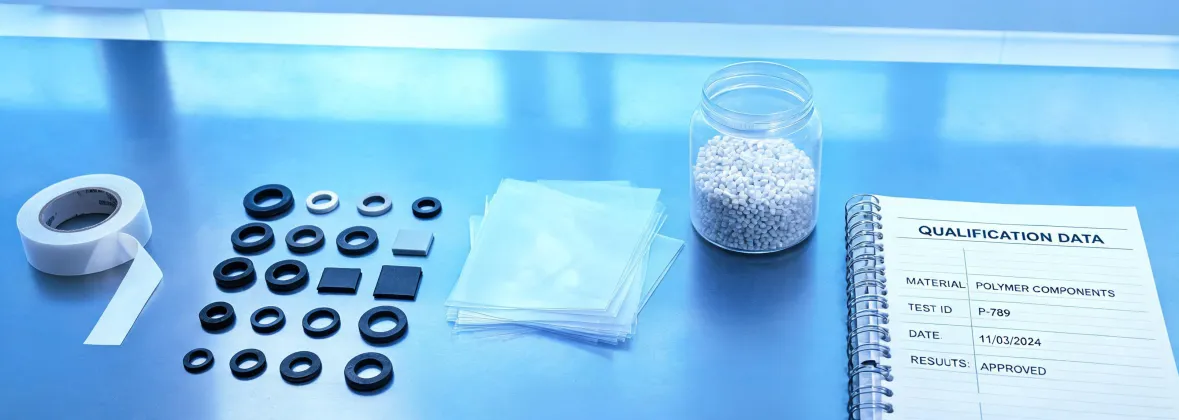
Seventy-two hours before a client's trade show, their prototype cracked. The spec sheet said polypropylene. The bid was cheap. The deadline was non-negotiable. They called us in an absolute panic. The fix? A switch to polycarbonate, a 3M acrylic adhesive upgrade, and a surface polish done right. The whole thing cost about triple the original material cost. Honestly, that was the good outcome.
When you're comparing polycarbonate vs polypropylene vs ABS, what's the first thing that comes to mind? Price. Tensile strength. Maybe heat resistance. If you're sourcing for a production line, you probably pull up a few data sheets, check the unit price, and place the order. That's exactly what we did for years. And it cost us.
Here's the thing: data sheets don't tell you how a material behaves in real manufacturing. They don't tell you whether your adhesive is going to stick. They don't tell you what happens when the surface gets scratched and someone needs a polycarbonate polish under time pressure.
The Problem Isn't the Spec Sheet. It's Everything After It.
From the outside, material selection looks like a comparison of physical properties. The reality is it's a compatibility test for every step that comes after the sheet leaves the factory. I see the same mistake in almost every rush order: someone picks PP because it's cheap and chemical-resistant, then expects it to bond with a standard acrylic adhesive. Polypropylene is a low-surface-energy plastic. Most adhesives simply don't grab it without corona treatment or flame treatment. So the “cheap” material creates an expensive problem.
ABS? It bonds beautifully with 3M acrylic adhesives, but it's not UV-stable. Polycarbonate? It's tough, but it scratches if you look at it wrong. That's where a proper polycarbonate polish matters—and not all polish is the same. And if your design involves a rubber membrane bonded to a plastic panel, you need to verify adhesive compatibility with both substrates. That's a step people miss all the time.
In my role coordinating rush production for industrial clients, I've dealt with this pattern enough times to spot it immediately. A customer needs 40 thermoformed trays. The buyer substitutes PP to save $0.30 per sheet. Then the graphics won't adhere. The silicone foam tape peels off. The whole batch gets rejected. The schedule goes sideways.
According to 3M's technical guide for low-surface-energy plastics (accessed January 2025), polypropylene requires surface preparation before bonding. That's not a rumor—it's on the spec sheet.
What the High-Pressure Moment Reveals
People assume rush orders are just about expedited shipping. What they don't see is that rush orders expose every flaw in the spec. A material that's merely “okay” for a four-week timeline becomes a crisis in 72 hours. Surface prep, adhesive cure time, polishing technique—all of it gets compressed.
Last quarter, we processed 47 rush orders with 95% on-time delivery. The ones that slipped were never about speed. They were about material choices made at the beginning. One order needed a silicone foam 3M tape supplier who understood surface energy. Another needed a polycarbonate polish process that wasn't even in the original quote. Both of those caused rework.
I only believed in total cost thinking after ignoring it once. Everyone told me to check the full process before choosing a material. I didn't listen. We saved $0.30 per sheet on PP and ate a $1,700 loss in rework and rush fees. That lesson stuck.
The Real Price of “Cheap” Material
Let me give you a concrete example. In March 2024, a packaging customer needed 40 clear thermoformed trays in 72 hours. The design originally specified polycarbonate. The buyer switched to polypropylene to cut costs. When the trays arrived, the adhesives wouldn't hold. The silicone foam tape lifted at the edges. The surface couldn't be polished to the required clarity. We had to redo the run in PC, use a 3M acrylic adhesive, and pay for expedited shipping.
Total bill: $2,800. The original quote was $1,100. The “savings” turned into a $1,700 loss—and that's ignoring the customer's near-miss with a penalty clause.
The same logic applies to rubber membrane assemblies. A rubber membrane might look easy to bond to a plastic substrate. But if the adhesive isn't formulated for both materials, the bond fails under heat or humidity. Then you get field failures, warranty claims, and a reputation hit. None of that shows up on a material price chart.
The TCO Approach: What Actually Works
So what do you do? Stop choosing materials by unit price alone. Start with the full process: cutting, machining, bonding, polishing, and deadline. Build a total-cost-of-ownership calculation.
- Material unit price
- Surface prep and adhesion promotion
- Adhesive or tape cost—including the right 3M product for the substrate
- Finishing requirements, such as polycarbonate polish
- Rework risk and scrap rate
- Rush delivery fees if the timeline gets tight
If you're sourcing silicone foam 3M tape, ask the supplier for surface energy data and test results. If you need a polycarbonate polish, budget time for the right compound and a controlled environment. If you're bonding a rubber membrane to a plastic panel, verify the adhesive works with both materials. These steps take an extra hour at the front end and save days on the back end.
Bottom line: the cheapest material on the spec sheet is often the most expensive thing in your factory. In high-pressure situations, total cost isn't a theory. It's the difference between hitting the deadline and explaining why you missed it.
I've been on the wrong side of that math. Not anymore.