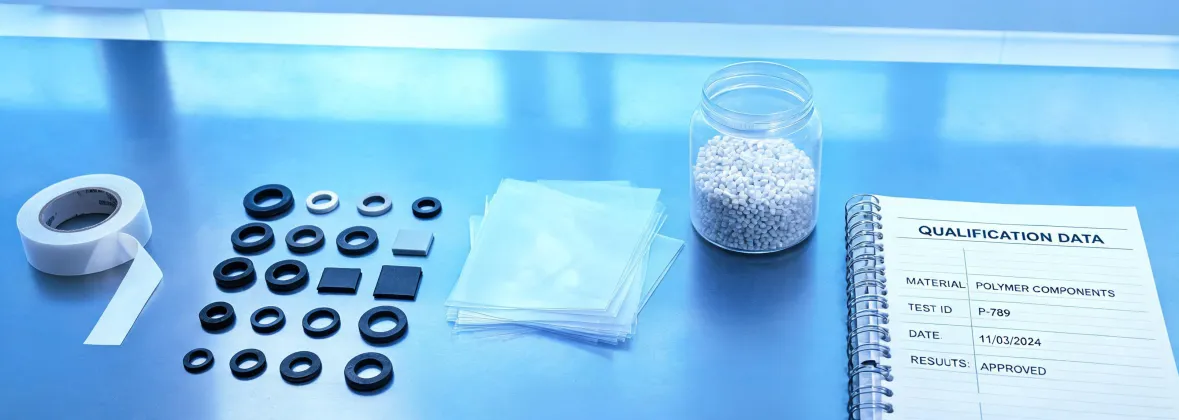
It started with a frantic email from our packaging conversion department on a Tuesday afternoon. 'We've got a rush order for a client building a clean-room assembly jig, and the spec calls for bonding a custom EPDM rubber gasket to an ABS sheet. The rubber and the adhesive won't stick. We're down to 48 hours. What do we have in the warehouse that can handle this?'
As the quality manager, my first instinct was to ask about surface energy and contamination. But in the moment, everyone was in a panic, and the deadline was looming. They'd already tried a generic cyanoacrylate and a two-part epoxy. Both failed the 90-degree peel test after four hours. The materials, they said, were 'just weird.'
The Classic Stopgap Problem
Here’s where I see a lot of companies in our industry make a costly mistake. They look for a cheaper or 'in-stock' solution first, rather than a correct one. This is the classic 'penny-wise, pound-foolish' trap, and I've been guilty of it myself. In our case, the 'budget' adhesive was failing, and we were burning through our actual budget on labor, trying to re-apply and clamp pieces that were never going to hold.
The core issue wasn't the viscosity or the open time; it was the structural incompatibility between the substrate (ABS), the elastomer (EPDM), and the need for a rapid, high-strength bond. From the outside, it looks like any industrial adhesive should work on plastic and rubber. The reality is that EPDM is notoriously non-polar and requires specialized adhesion promoters or intentionally aggressive resin chemistry.
Understanding the Materials: EPDM vs. Silicone
To understand why we were struggling, it helps to clarify what we were actually dealing with. The client's original spec said 'rubber sandals'... no, wait, that's the supplier's product line—I mean, the client spec for the jig required a 'flexible, high-temp elastomer.' The engineers on our floor initially assumed this meant silicone, which is a common go-to. This is a huge mistake.
For anyone searching for a simple definition: EPDM (Ethylene Propylene Diene Monomer) is a synthetic rubber known for its excellent weather resistance, ozone resistance, and thermal stability. It's used in roofing membranes, automotive weather-stripping, and even some hose applications. Silicone gels, on the other hand, are often used for their extreme temperature range and softness, but they have poor tear strength and are terrible to bond adhesives to without a primer. We confirmed the client's material was definitely EPDM, not silicone—that's a critical distinction when choosing an adhesive.
The Shift to 3M PPS 2.0 and Relyx Resin Cement
After the initial, failed attempts with generic adhesives, I made the call to stop improvising. I remember thinking, "We're not going to test our way out of this in 48 hours." We needed a system that was designed for high-assurance bonding, not just a glue from a bottle. That's when we pulled out the 3M Relyx Universal Resin Cement from the controlled storage cabinet.
Now, most of our inventory is PVC, PET, PS, and acrylic sheets. We're a plastics supplier, not a dental or medical device maker. So, the Relyx product was something we had on hand for a specific internal project—a custom acrylic enclosure for a sensitive sensor. It's a self-adhesive resin cement that's incredibly versatile. It can bond to a wide range of materials, including metal, unless you count the aluminum frame we were installing for an in-house assembly line. Interestingly, the same chemistry that makes it an excellent dental cement—high bond strength and low solubility—makes it a powerhouse for industrial plastic and rubber bonding.
A key component in the success was the application system. Using the 3M PPS 2.0 (Positive Pressure System) cup wasn't just a fancy way to mix the resin. In a rush environment, the PPS 2.0 setup is a game-changer because it eliminates the mess and the guesswork of manual mixing. It allows for direct, measured application into the bond line. The system provided a controlled, consistent flow of adhesive, which is critical when you're trying to cover a large surface area of 8,000 units, or in this case, the perimeter of a complicated jig frame. Don't hold me to the exact square footage, but it was a large piece.
A Lesson in Surface Preparation
Some operators thought the specialty resin cement would magically bond through any surface condition. I had to enforce a strict protocol. The EPDM needed a solvent wipe to remove mold-release agents. The ABS sheet needed a light mechanical abrading to promote adhesion. I hear stories about other factories skipping this step—they just apply the adhesive to a smooth, shiny plastic part and wonder why the bond looks perfect for an hour then fails under stress.
It wasn't just about the chemical bond; it was about the interface. The Relyx resin has a unique feature: it's hydrophilic, meaning it can tolerate a slight amount of moisture on the surface without a significant loss of bond strength. But it doesn't forgive grease. We learned that after the first batch of test panels failed because a technician handled the parts with ungloved hands.
The Result and The Reflection
We completed the custom bonding job in four hours, with a bond strength that exceeded the client's specification. We saved the $15,000 rush order. But that success wasn't just about having a magic glue. It was about having the right system (the PPS 2.0 cup) and the right material (the Relyx cement).
Here's the thing I wish I had tracked more carefully: the total cost of that initial 'cheaper' adhesive failure. We wasted $250 in material and two full days of labor. The 3M Relyx cost a premium per ounce compared to generic acrylic cement, but it eliminated the rework entirely.
The experience solidified my belief in the 'time certainty premium.' In our warehouse, we now stock 3M Relyx Universal Resin Cement and the PPS 2.0 cups as a standard SKU for on-demand emergency bonding requests. It's more expensive upfront, but as I told our GM: 'In March 2024, we paid a premium for a reliable bond. The alternative was missing a $15,000 order and damaging our reputation.'
Honestly, I'm not sure why some purchasing managers still try to save $50 on a specialty adhesive when they are facing a $10,000 liability. My best guess is that they view all adhesives as 'glue,' not as engineering materials. If you're working with EPDM, Teflon, or strange polyolefins, do your research. Understand what EPDM rubber is, identify whether the part is actually silicone gel or a polyurethane, and then—crucially—invest in an application system like the 3M PPS 2.0 that ensures you don't botch the mixing. The certainty of hitting your deadline is a competitive advantage worth every cent of the premium.