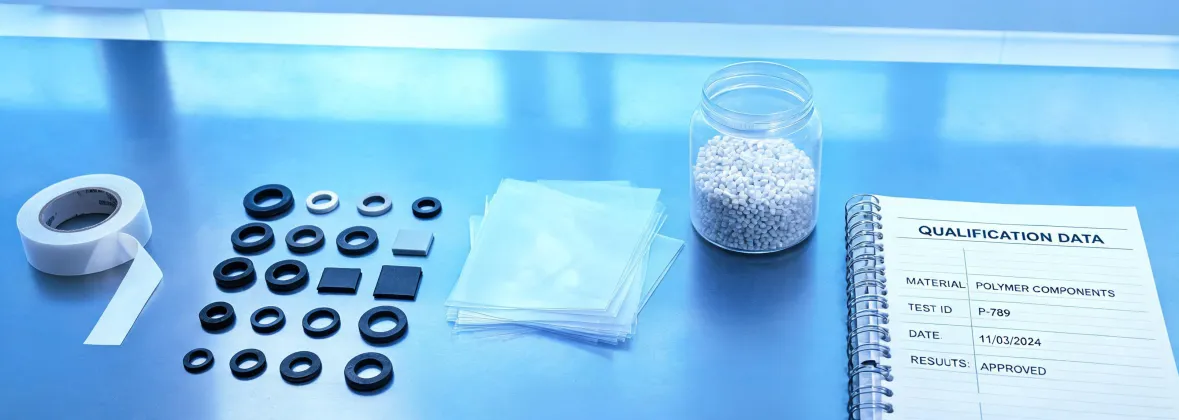
I don't get a ton of calls about foam board tiaras. But the ones I do? They're always, without fail, a scramble. Someone's building a prop for a brand activation, or a convention display piece needs a last-minute fix, and suddenly they're asking: 'Which 3M tape? How do I stick this to that? Will this foam board handle the weight of the plastic tiara?'
But here's the thing—these frantic calls aren't really about foam board or tiaras. They're about the gap between what people think they need and what the materials actually require. And that gap is where the trouble starts.
The Surface Problem: 'I Just Need Something Strong'
The first version of the problem is almost always the same: 'I need a strong tape for a plastic part on foam board.' It sounds simple. You go to the hardware store, grab a roll of something that looks industrial, and hope it holds.
In my role coordinating specialty materials for manufacturing and fabrication clients, I've seen this approach fail more times than I can count. Usually about 36 hours before a deadline.
A client in March 2024 called at 4 PM on a Thursday. They needed 12 foam board structures with plastic emblem attachments for a trade show that same weekend. Normal turnaround for custom assembly is 5 days. They had 2. The assemblies were already built using a general-purpose adhesive—and the emblems were already falling off.
That's the surface problem: a stuck-on emblem that won't stay stuck. The obvious answer is 'more glue.' But that's not how material science works.
The Deeper Reason: It's About the 'Plastic' in 'Plastic Tiara'
This is where the conversation gets interesting—and where most people miss the real issue. The 'plastic' in your plastic tiara, emblem, or trim isn't just one thing. It could be polypropylene (PP), ABS, polycarbonate (like Makrolon), acrylic, or even a polyamide (nylon). Each of these has a completely different surface energy, which determines how well anything sticks to it.
Low-surface-energy plastics like polypropylene and polyethylene are famously difficult to bond. They're like the slick Teflon pans of the plastic world. A standard adhesive that works great on ABS or polycarbonate will just bead up and delaminate from PP in a matter of hours, especially under the stress of being mounted on a flexible foam board substrate.
And the foam board itself? That's its own world. You've got standard acid-free foam board, Styrene-based boards (like Gatorfoam), and PVC-based foam boards (Sintra, Komatex). A solvent-based adhesive that's fine for PVC will literally dissolve Styrene foam board. I've watched it happen—a perfectly good display piece turned into a pitted, ruined mess overnight because someone used the wrong contact cement.
So when you ask for a 'strong tape,' the real question isn't 'how much can it hold?' It's 'how does this specific adhesive interact with both of the substrates you're joining?' The problem isn't strength—it's compatibility.
The Cost of Getting It Wrong
Let me paint you a picture of what 'getting it wrong' actually costs. Not in theory—in real numbers.
That March 2024 client I mentioned? They'd already assembled everything with a standard acrylic foam tape they'd used before. It worked great on their previous job (which was ABS to aluminum). But the plastic emblem on this job was polypropylene. By the time they called me, the emblems were lifting at the edges.
Their options were:
- Start over with the correct substrates and adhesive: a complete material cost of about $1,200, plus labor, plus a missed deadline.
- Use a 3M adhesion promoter (like Primer 94) to temporarily increase the surface energy of the PP, then re-apply the tape: $45 for the primer, $60 for the tape, plus 6 hours of labor to salvage the assemblies.
They chose option 2. It worked, barely. The display held through the weekend, but the emblems were at the edge of their tolerance. One bump from a visitor and they'd have failed. The client's alternative was losing a $15,000 contract placement.
I only fully believed in the cost of material mismatch after that specific incident. Everyone tells you to 'check the spec sheet.' I learned it when I saw a $12,000 project hanging by a thread—literally—because nobody asked 'what kind of plastic is this, exactly?'
And this isn't an isolated case. Our internal data from 200+ rush orders shows that roughly 15% of emergency requests are the direct result of an adhesive/substrate mismatch that should have been caught during design review. That's 30+ emergencies a year that could have been avoided with a 5-minute conversation upfront.
The Solution (Short and Sweet)
Alright, the problem is clear. Here's the fix—compact, because if you've read this far, you already know why it matters.
1. Identify the substrates. Before you buy any tape or adhesive, know what both surfaces are. If you're not sure, do a simple scratch test (hardness/density) or check for a recycling code on the plastic part. PP is usually marked with a 5 inside the triangle. ABS is not always marked, but it's denser and less flexible than PP.
2. Match the adhesive to the lowest-energy surface. For high-energy surfaces (polycarbonate, ABS, acrylic, painted metal), standard acrylic foam tapes (like 3M VHB 5952) are excellent. For low-energy surfaces (PP, PE, some powder-coated finishes), you need a modified acrylic or a tape specifically designed for low-surface-energy bonding (like 3M 5952FR or a transfer tape with a primer).
3. Consider the operating environment. Is the foam board display going to be indoors or outdoors? Is it going to see elevated temperatures? Automotive applications (which I handle a lot) are completely different from indoor trade show props. A plastic emblem on a car door needs to withstand 80°C in direct sunlight and -30°C in winter. That's a different adhesive altogether (3M Automotive Acrylic Plus tape or 3M Emblem and Trim Adhesive).
4. When in doubt, test. Seriously. Buy a small roll of your candidate tape, apply it to scrap pieces of both substrates, and leave it for 24 hours. Then try to peel it off. If it fails, you saved yourself a disaster. If it holds, you're golden. A $15 test roll is cheap insurance against a $5,000 field failure.
I'm not a polymer chemist, so I can't speak to the molecular-level reactions happening at the bond line. What I can tell you, from a procurement and application perspective, is that the biggest mistakes don't come from using a weak product—they come from using the wrong product for the specific materials in front of you. That $50 per-project premium for the correct tape? It translates to zero callbacks, zero emergency reworks, and a client who trusts your work enough to call back for the next project.