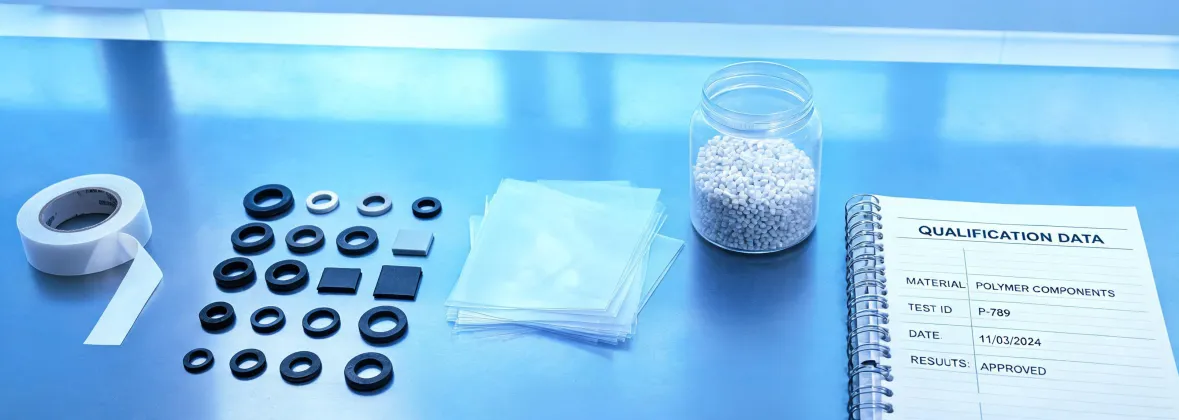
When I first started sourcing materials for plastic fabrication and bonding, I assumed 3M was just one brand with a few good tapes. I figured if I picked something with the right width and thickness, I'd be fine. That assumption—made back in my first year, 2017—cost me about $2,800 in wasted materials, rework, and delays before I understood the real landscape.
This isn't a guide to every 3M product. It's a walk through the mistakes I've made with 3M Bondo body filler, 3M die cut tape, resin pour applications, rubber plugs, and the surprisingly tricky decision between PVC vs foam board. If I can save you even one of the errors I've documented, this will be worth your time.
The $890 Die-Cut Tape Mistake
In September 2022, I ordered 500 pieces of what I thought was a straightforward 3M die cut tape for mounting plastic emblems and trim onto an automotive interior component. The part was a polycarbonate (Makrolon) panel, about 8x10 inches. I specified a standard acrylic foam tape, 1/16-inch thick, with a removable liner.
The order came back. I checked the first piece. Looked fine on my screen. Approved it.
Three days later, the customer reported that the tape wasn't bonding. The emblems peeled off within hours. 500 items, $890, straight to the trash.
Here's what I didn't know: Polycarbonate, especially the flame-retardant grades used in automotive interiors, requires a specific surface energy and a particular adhesive formulation. My off-the-shelf die-cut tape selection didn't account for the substrate's real surface chemistry. I learned that day that 'die cut tape' isn't a product—it's a process. The adhesive family (acrylic, silicone, rubber-based) and the exact liner selection (which affects die-cutting precision) are critical decisions I hadn't made.
I now maintain a pre-order checklist that asks six questions about the substrate before any die-cut tape order. That checklist has caught 47 potential errors in the past 18 months. Not one bonding failure since.
Resin Pour: When the 'Easy' Route Is a Trap
I've done maybe 50 resin pour projects for industrial prototype enclosures and smaller production runs. My initial approach was completely wrong. I thought any polyurethane or epoxy was basically interchangeable for casting into a silicone mold.
In October 2023, I ran a resin pour using a 3M two-part polyurethane. The results were fine—if by 'fine' you mean brittle, yellowed, and slightly tacky on the surface. The client rejected the entire 200-piece order. The redo cost $450 plus a one-week delay.
The problem? I'd chosen a resin optimized for structural strength, not for UV stability or aesthetic clarity. For a resin pour where the surface is visible (and in this case, backlit), you need a formulation designed for optical clarity and minimal shrinkage. 3M's polyurethane line alone covers dozens of variants: some for potting electronics, some for casting decorative parts, some for high-temperature environments. They're all 'resin pour' products, but they're absolutely not the same.
I also learned to check the pot life of the resin. A resin pour into a complex mold with tight tolerances? If you have a 5-minute working time and a 50-cavity mold, you're in trouble before you start.
Honestly, I'm not sure why the industry doesn't standardize resin pour classifications better. My best guess is the material science is too diverse. So now I request technical data sheets 48 hours before ordering. And I always, always run a small test pour first. Because one bad batch can ruin a week's production.
Rubber Plugs: The 'Standard' Lie
Learned never to assume 'standard' means the same thing to every vendor after an incident with rubber plugs.
In January 2024, I needed 1,200 rubber plugs for sealing holes in a steel automotive panel before a cavity wax application. The spec was simple: neoprene, 1-inch diameter, dome head. I ordered from a vendor I'd used before, approved the sample, and went to production.
The whole order arrived. Checked it myself, approved it, processed it. We caught the error when the first 200 parts went through the wax line. The rubber plugs were shrinking. Not a lot—maybe 2-3%—but enough to let the cavity wax seep past and contaminate the interior. $1,200 wasted, credibility damaged, lesson learned: specify durometer (Shore A) and tolerance for each batch.
The manufacturer had used a slightly different neoprene compound that had a different compression set. A 'standard' rubber plug doesn't exist. 3M's rubber and plastic parts catalog alone covers EPDM, neoprene, silicone, nitrile, and TPE formulations. Each has different resistance to oils, temperature ranges, and compression characteristics.
I now have our team's checklist that requires confirming the specific polymer family and durometer for every rubber plug order. It's saved us from at least three near-misses since then.
PVC vs Foam Board: The Decision No One Warned Me About
The choice between PVC vs foam board sounds simple. It's not. And I learned this the hard way on a trade show display project in early 2023.
I needed a rigid, lightweight substrate for printed graphics. I assumed foam board (the polystyrene core type) was always the cheaper, lighter option. So I ordered 50 sheets of 3/16-inch foam board. The print shop mounted the graphics. Looked great.
Then it rained.
The foam board warped. The edges delaminated. The customer complained within 48 hours. Cost: $320 in replacement material plus the rush printing—I paid $200 extra just to get it done in two days instead of seven. The rush fee hurt, but that's a topic for another day.
What I learned: PVC vs foam board isn't about cost. It's about environment.
PVC (foam PVC, like 3M's plastic sheeting) handles moisture, temperature swings, and physical impact much better. It machines cleanly, accepts paint and adhesive well, and lasts years outdoors. Foam board (usually polystyrene or paper-faced) is lighter, cheaper to ship, and perfectly adequate for indoor, controlled environments—but it's a disaster outdoors or in high-humidity settings.
Since that error, I have a decision flow: indoor-only, short-term? Foam board. Outdoor, long-term, or any risk of moisture? PVC. It's not about which is 'better.' It's about matching the material to the real conditions.
The Quick Fix That Wasn't: Bondo Body Filler
I've used 3M Bondo body filler for years on automotive panels and fiberglass repairs. It's a reliable product. But I made a classic mistake in February 2024: assuming it works the same way on every plastic substrate.
I was fixing a gouge in a thermoplastic polyolefin (TPO) bumper. Mixed the Bondo body filler, applied it, sanded it. Looked perfect. The next day, the filler had cracked along the repair edge. The TPO had a low surface energy; the body filler didn't adhere properly despite my prep work.
The fix cost me $150 in material and a half-day of rework. I now check the plastic substrate identification (using a simple burn test or identification chart) before any Bondo body filler application on a non-metallic surface. And I use a plastic-specific adhesion promoter first.
What I'd Do Differently (And What I Do Now)
After roughly $2,800 in documented waste across these mistakes, here's my simplified approach for any 3M material selection for plastics and rubber:
- Identify the polymer of your substrate. 3M covers 50+ families. It matters.
- Check the adhesive chemistry for tapes. Acrylic, rubber, silicone—they're not interchangeable.
- Test before committing. A $50 sample kit is cheaper than an $890 redo.
- Read the technical data sheet for pot life, substrate compatibility, and temperature range.
- Ask about die-cut liner compatibility if you need custom shapes. Not all liners cut cleanly.
This was accurate as of January 2025. Materials and formulations evolve, so verify current data with 3M's technical support before you order.
I've made my share of mistakes so you don't have to repeat them. If you've got a similar story or a better approach, I'm honestly curious to hear it.