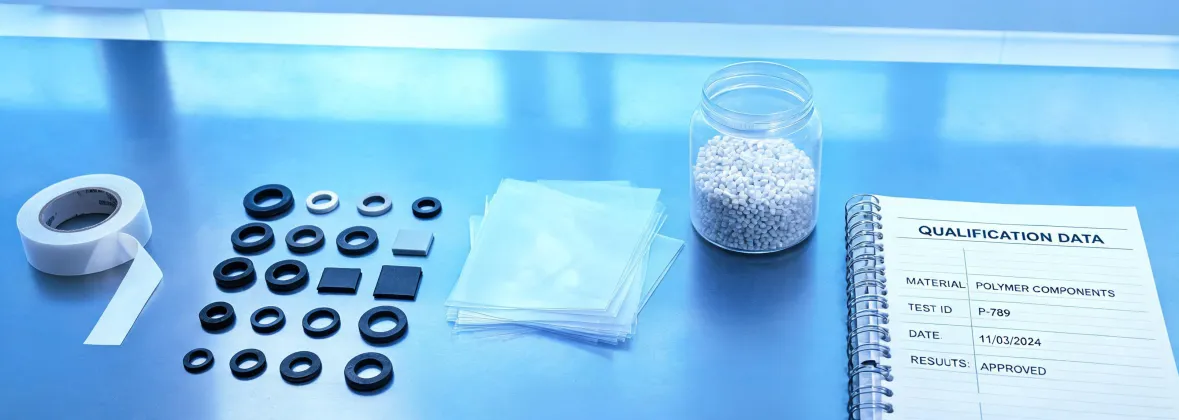
"3M store" – that's what I typed into my search bar on a Tuesday afternoon. I needed three things: nitrile rubber balls for a maintenance customer's pneumatic system, a neoprene rubber gasket for an odd-sized transformer box our electrician found, and a foam board for a packaging prototype. Simple, right?
I assumed I could get all three from one place, one order, one invoice. That was my initial misjudgment. When I first took over purchasing in 2020, I figured that the biggest vendor with the most SKUs was the safest bet. Three projects, three different material families; surely 3M’s product breadth across 50+ polymer families meant it was all under one roof. I assumed that three simple items would be easy.
Surface Level: The Three Items
On paper, it shouldn't have been hard. Let's look at each request. A customer needed nitrile rubber balls for a check-valve application. Another internal client wanted a custom-cut neoprene rubber gasket. And my packaging engineer needed a specific thickness of foam board for a shipping insert.
I pulled up our approved supplier list and started checking catalogs. According to USPS (usps.com), as of January 2025, a First-Class Mail large envelope costs $1.50. That was relevant because I figured I could have samples shipped quickly. But I couldn't even get a sample of the neoprene gasket material because no one stocked the specific 1/8" thickness.
The questions started piling up. "Is it a closed-cell or open-cell neoprene?" "What durometer for the nitrile balls?" "Is the foam board polyethylene or polyurethane?" I didn't know the answers. Processing 60-80 orders annually, I had learned most product categories, but this trifecta—rubber, rubber, and foam—caught me off guard.
The Deep Dive: Why This Was Harder Than It Looked
The core problem wasn't finding the products. The problem was material science ambiguity. These aren't like buying paperclips or printer toner. They are specific chemical compounds with properties that vary wildly.
Nitrile vs. Neoprene
Let me rephrase that: I thought they were both just "rubber." What I mean is, I didn't understand why the customer couldn't just use the same material for both. Here's the difference that cost me two weeks of research:
- Nitrile (Buna-N): Excellent for oil resistance. Those balls needed to function in a pneumatic system with lubricants. Nitrile was perfect for that.
- Neoprene (Chloroprene): Better for weather and ozone resistance. The transformer box was outdoors. Neoprene was the right call for the gasket.
If I had just ordered "rubber balls" without specifying nitrile, I might have gotten EPDM or natural rubber ones. They would have failed within a month, absorbing the oil and swelling up. That's a failure of a $6 part causing a $400 service call. I've seen that happen.
The Foam Board Trap
And then there was the foam board. I asked for "foam board." The budget printers I use for signs might charge $15 for a standard foam core board. But for an industrial packaging application—one that needed to cushion a $10,000 instrument—this wasn't a sign. It needed to be load-bearing, non-shedding, and possibly anti-static. That's not standard foam core. That's polyethylene or polyurethane cross-linked foam. According to online printing pricing, which I checked in January 2025, a 4x8 sheet of standard foam board runs about $10-20. The high-density polyurethane foam I actually needed? Over $100 a sheet. I had to justify that to my VP.
"The unreliable supplier made me look bad to my VP when I couldn't explain why a simple 'foam board' cost five times more than he expected."
The Hidden Costs of Getting It Wrong
This isn't just theory. Let's talk about what happens when the procurement admin gets this wrong.
Case 1: The Nitrile Ball Defect. A vendor I'd never used before offered a fantastic price on "rubber balls." I didn't request a spec sheet. They weren't nitrile. They were a cheap SBR blend. After three weeks in the system, they disintegrated. The customer's machine failed. The vendor who couldn't provide proper material certs cost us $2,400 in replacement parts and lost labor.
Case 2: The Wrong Gasket. This is a classic. My electrician told me he needed a "neoprene gasket." I found one in stock at a local distributor. It was a closed-cell neoprene. His application required a solid, dense neoprene. The closed-cell stuff would compress too much under the bolt torque, seal poorly, and leak. I learned that lesson the hard way when the seal failed during a rainstorm. Not ideal. Not ideal at all. I should have asked for the durometer and the density.
Case 3: Foam Board Contamination. The packaging foam I ordered was standard polystyrene. It shed particles. The clean room where the instrument was assembled rejected the whole batch. That $150 worth of foam caused a $2,000 production delay.
These are the consequences of surface-level procurement. The total cost of these errors in our 2024 fiscal year was roughly $4,800 across similar incidents. That's a number I track personally.
When to Go to the 3M Store (And When Not To)
So where does 3M fit into this messy reality? 3M isn't just a "store" in the sense of a single web page. It's a specification authority. The question isn't "can I buy this at the 3M store?" The question is "is this a problem 3M has already solved with a specific product number?"
I recommend going directly to a 3M distributor for these specific scenarios:
- For VHB tape and acrylic foam adhesives: 3M owns this category. Their 5952 series is the benchmark. If you need to bond materials without welding, this is your lane.
- For specialty films and protective surfaces: They have solutions for specific surface energy challenges (polypropylene, polyethylene) that commodity vendors don't optimize for.
- For PPE (gloves, faceshields): The regulatory compliance (ANSI, CE) is already baked in.
But here's the honesty you deserve. If your project involves standard nitrile rubber balls (a commodity item for check valves), you might do just as well—or better—with a specialized rubber supply house. They'll stock the correct durometer (70A is standard for many pneumatic valves) and can get you a sample in a day.
If you need a neoprene rubber gasket for a non-standard application, don't assume the foam board supplier knows neoprene. A gasket supply house is better. They will ask you the questions you didn't know to ask: "Are you sealing oil, water, or gas?" "What's the temperature range?"
And for foam board for packaging? The 3M store is competitive if you need their specific high-performance foams (PE, PU for the PP/PET industries). If you just need a cheap foam core board for a craft project, don't waste your budget with an industrial supplier. Go to an art supply store or an online printer that sells standard foam core for $15.
Had 2 hours to decide before a deadline for our 2024 vendor consolidation project. Normally I'd get three quotes for each material, but there was no time. I went with a single-source distributor who could aggregate all three. In hindsight, I should have pushed back on the timeline. But with the COO waiting, I made the call with incomplete information. I paid a premium for the neoprene and the foam board, and I had to source the nitrile balls separately anyway. It wasn't a disaster. But it wasn't efficient.
My advice is simple: don't try to be a materials scientist. Know the difference between a commodity and a specialty product. When in doubt, pay for the spec sheet. And always, always verify the specific polymer family (nitrile, neoprene, polyurethane, polyethylene) before you hit "buy." A single wrong click on a $10 part can cost your company $2,400 in downstream pain.
I'm sticking with 3M for the things they dominate: adhesives, tapes, and PPE. For rubber balls and standard gaskets? I'm calling a specialist. Put another way: I've stopped trying to buy everything from one place. It's a lesson learned the hard way, but it's saved my accounting team about six hours of rework per week.