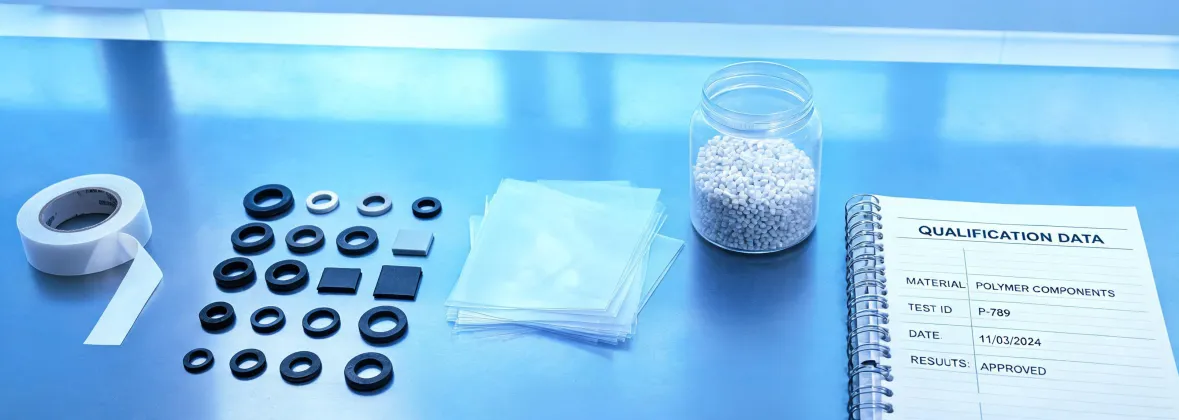
I'm a materials specialist at a rubber and plastics company. I've handled over 200 rush orders in the last 15 years, including same-day turnarounds for automotive assembly lines and medical device manufacturers. When a client calls at 5 PM needing 500 rolls of a specific tape for an 8 AM prototype build the next day, I'm the one figuring out if it's possible. And for that, I need to know the materials inside and out, especially the ones that look the same but behave completely differently.
The most common question I get isn't about VHB tape or high-temperature silicones. It's about the basics: "Which should I use, PVC tape or polypropylene tape?"
You'd think there's a simple answer. There isn't. And the wrong choice can shut down a production line or, worse, cause a regulatory failure. It took me about 5 years and 150+ specific incidents to understand that the 'best' tape is highly context-dependent. I don't have hard data on industry-wide failure rates for this specific comparison, but based on our internal data from 200+ rush jobs where we had to source one or the other, my sense is that about 15% of first-time selections are suboptimal. Period. That's a big number, and it costs time and money.
The Surface Problem: "Which Tape Costs Less?"
Most people start here. They look at the unit price. PVC (polyvinyl chloride) tape is usually cheaper. Polypropylene (PP) tape costs a bit more. The decision often ends there.
I get calls all the time: "We need a general-purpose tape. The cheapest option." This was the case in March 2024. A client called at 4 PM on a Thursday. Normal lead time for custom tape slitting is 5 days. They needed 200 rolls of a 1-inch wide tape for a regulatory compliance audit happening on Saturday. The audit was specifically checking how their secondary packaging was sealed. The client's alternative was failing the audit, which meant a $50,000 penalty clause.
They wanted the cheapest tape. I pushed back. Why? Because the cheapest tape wasn't the right tape.
The Deeper Issue: It's Not About the Price Per Roll
The question isn't "PVC vs. Polypropylene." The question is "What properties does your application require?" The total cost of ownership (TCO) includes the unit price plus shipping, plus the cost of application failure, plus the risk of regulatory non-compliance. The $500 quote can turn into $800 after rush shipping, and if the tape fails the audit, the cost is unquantifiable.
Here's the core difference, stripped of marketing jargon:
- PVC Tape: Flexible, conformable, good for irregular surfaces, works well at lower temperatures, can have very high adhesion. But it has a limited UV resistance (it degrades in sunlight), can plasticize (leak oils), and has a lower tensile strength.
- Polypropylene Tape: Higher tensile strength, excellent clarity, good chemical resistance, better UV stability, and a cleaner, more consistent unwind. But it is less conformable (won't wrap around corners as well), and its adhesion can be lower on certain low-surface-energy plastics.
That's the theory. Here's the reality.
The Cost of Getting It Wrong: A 36-Hour Emergency
Back to my March 2024 rush order. The client was sealing corrugated boxes that held medical device components. The audit required that the tape seal be tamper-evident and that it not leave residue when removed (for inspection purposes). The boxes were going to be stored in a non-climate-controlled warehouse for up to 6 months before distribution.
The client's procurement manager wanted to order the cheapest PVC tape. It was $12 per roll. The polypropylene tape was $18 per roll. Simple math says PVC is cheaper. Wrong.
Here's what I saw:
- UV and Heat: PVC tape degrades in UV and heat. Stored in a metal warehouse for 6 months in summer? That tape would become brittle and yellow. It could fail to be tamper-evident.
- Plasticizer Migration: PVC contains plasticizers. In a sealed box with medical components? That's a contamination risk. The FDA and ISO standards for medical packaging explicitly warn against certain plasticizers.
- Removal Residue: PVC tapes, especially cheaper ones, can leave a gummy residue. For an audit where the box might be opened and resealed? That's a red flag.
I convinced them to go with the polypropylene tape. It cost $6 more per roll, or $1,200 more for the whole order. But we also paid $400 in rush fees to the slitting vendor and $200 for overnight shipping. The total cost was $1,800 more than the 'cheap' quote.
But the alternative was failing the audit (a $50,000 penalty), or having a product contamination complaint (priceless in reputational damage). The polypropylene tape passed the audit. The client's warehouse manager called me a week later: "Best decision we made. We're switching all our tape specs."
The Second Blind Spot: Application Surface
Another common mistake is assuming tape sticks to everything the same way. I've tested about 50 different substrates for tape adhesion over the years. Polypropylene tape is excellent on paper, cardboard, and most plastics. But on a polypropylene box itself? Not so much. We call that 'fighting the enemy.' Polypropylene is a low-surface-energy material. Polypropylene tape is a polypropylene backing. They don't like sticking to each other unless you use a very specific primer or a rubber-based adhesive.
PVC tape, because it's more conformable and often uses a different adhesive system, can sometimes bond better to rough or textured surfaces. For example, sealing a machine filter bag or wrapping a wire harness? PVC is often the better choice.
The rule of thumb I use (which I learned the hard way after 3 failed experiments with cheap tape on packaging lines):
- Use Polypropylene Tape for: Clear labeling, sealing cartons for long-term storage, applications requiring high tensile strength (like bundling), or where UV resistance is needed.
- Use PVC Tape for: Electrical insulation (with proper ratings), conforming to irregular shapes, low-temperature applications, or general bundling where flexibility is key.
I wish I had tracked the number of times a project failed because someone used the wrong tape. What I can say anecdotally is that in the last 2 years, we've had 12 emergency orders just to replace tape that was incorrectly specified. That's money, time, and trust down the drain.
A Note on Regulatory Compliance (The Unseen Factor)
We haven't even talked about regulations. Per FTC guidelines (ftc.gov), claims about a product's performance must be substantiated. When a supplier says their tape is "medical grade" or "food safe," you need to see the test report. PVC tape, due to its plasticizer content, often requires more documentation for medical or food contact applications. Polypropylene tape is generally simpler to certify. If you're in a regulated industry, the cost of certification and the risk of non-compliance can dwarf the price of the tape itself.
According to USPS (usps.com), as of January 2025, the cost to send a single roll of tape is $0.73 via First-Class Mail, but if you're shipping a pallet of the stuff, the cost is in the hundreds. That's another line item in the TCO.
So, PVC or Polypropylene Tape?
Here's my current take (remember, after 15 years and 200+ orders, I've come to believe that the 'best' vendor or material is highly context-dependent).
- If you need impact resistance, flexibility, and low cost for a short-term application: PVC is your friend. But don't expect it to last outdoors or in heat.
- If you need clarity, strength, UV resistance, and long-term stability (especially for storage or regulatory applications): Bite the bullet and pay for polypropylene. It's cheaper in the long run.
Don't just calculate the unit price. Calculate the TCO. The $18 roll of polypropylene tape is often the cheapest option when you factor in the time, risk, and cost of failure. I learned this the hard way, but you don't have to.