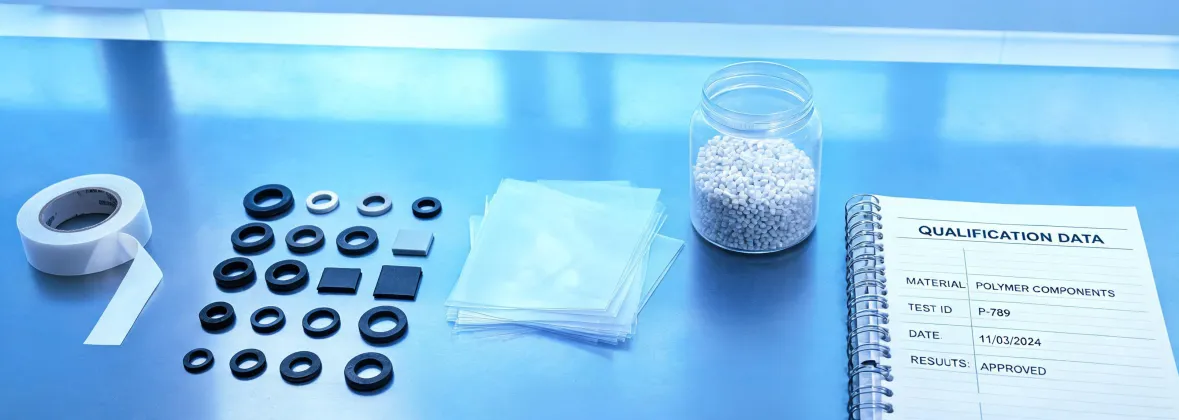
Not every maintenance job needs the same material
If you're like me—an office administrator or facilities buyer who handles everything from PPE to gasket sheets—you've stared at a supplier catalog wondering: Do I really need polyurethane foam, or will PE do? Is silicone worth it for labels? What about 3M's acrylic adhesive vs. their rubber-based stuff?
Here's the thing: there's no single 'right' answer. The right choice depends on what you're sticking, sealing, or padding, and what happens to it afterward. I manage procurement for a 250-person manufacturing facility—about $80K annually in MRO supplies across 12 vendors. I've made expensive mistakes buying the wrong foam or adhesive. Hopefully, this saves you a few.
Let me break this into three common scenarios I see on purchase orders. Each requires a different material logic.
Scenario A: You're sealing a vibrating joint—outdoor or high-temp
This is where you reach for polyurethane (PU). PU foam and 3M polyurethane sealants (like their marine or construction-grade stuff) handle compression, weather, and UV better than polyethylene (PE). I've used 3M's amber polyurethane sealant on HVAC flashings and tractor cabs. It bonds aggressively (note to self: wear gloves—this stuff does not wash off).
- Best for: Rubber gasket sheets on vibrating equipment, cavity wax in auto panels, outdoor seams.
- 3M pick: 3M Polyurethane Sealant 550 or 560 (check your local distributor, I paid ~$12.50/tube in November 2024).
- Watch out: PU degrades if it's constantly submerged. For that, you need butyl tape (I learned that the hard way on a roof patch).
Why not silicone here? Because silicone won't bond to itself later. If you ever need to service that joint, PU is less of a nightmare. (Silicone's great for glass and clean plastics, but not for gaskets that move.)
Scenario B: You need lightweight cushioning or insulation—indoor, dry
Here, polyethylene (PE) foam is your friend. Think foam boards for packaging, light gaskets on dust covers, or padding under metal panels. 3M's PE foam tapes (like their double-sided foam tapes) are dirt cheap compared to PU. I stocked them for a project where we needed 400 ft. of edge sealing on shelving. The difference? About $0.08/ft vs. $0.25/ft. (Prices based on our Q3 2024 supplier quotes; verify current pricing at your 3M distributor.)
- Best for: Low-stress sealants, indoor edge trim, emblem mounting (3M feels PE is fine for emblems if the surface is flat and clean).
- 3M pick: 3M Polyethylene Foam Tape 4026 or 3M Gasket Tape (the white stuff).
- Watch out: PE doesn't tolerate heat over 80°C. I had a roll warp on a printer stand near an exhaust. Switched to PU for that spot.
People think 'more expensive' means 'better in all cases.' Actually, PE foam's flexibility is exactly what you want for applications where you'll have to remove and replace it. PU wants to stay. PE lets you re-position. The causation runs the other way—the right material determines cost, not vice versa. (I'm not a materials engineer, so I can't speak to exact chemistry. What I can tell you from a procurement perspective is: test a sample before you buy bulk.)
Scenario C: You need labels, seals, or bonds that resist chemicals & weather
This is silicone territory. Silicone labels (e.g., rating plates on outdoor electrical enclosures) stay legible in UV, rain, and heat. They don't curl like paper nor yellow like plastic. I ordered 3M's silicone-based adhesive labels for a solar farm project last year. They cost more upfront—about $0.35/label vs. vinyl at $0.18—but they saved us a reprinting cycle when the client complained about fading. The $0.17 difference per label translated to noticeably better client retention.
- Best for: Serial number plates, warning labels on machinery, gaskets in chemical fume hoods.
- 3M pick: 3M Silicone Labels (custom order, lead time 3–5 weeks). For sealants, use 3M Silicone Sealant 795 (electrical).
- Watch out: Silicone doesn't bond well with other silicones. If you're patching a silicone gasket, you must use a primer. (I didn't know that. Cost me a $50 redo on a chiller line.)
And what about 3M acrylic adhesives? That's a fourth category, actually. Acrylic (like VHB tape) is the bridge between PU and silicone. It's more heat-resistant than PU but cheaper than silicone. If the decision is between tape and liquid sealant, acrylic tape is faster to install (no drying time). For a recent equipment skid, I used 3M VHB 5952 to mount a control panel—saved me a weekend of threading fasteners.
How do you know which scenario you're in?
Ask yourself three questions (in order):
- Is the joint/substrate moving or vibrating? → PU or acrylic tape. Not PE.
- Will the part be exposed to chemicals, UV, or rain >1 year? → Silicone or acrylic. Not foam unless it's closed-cell PE.
- Is this a low-stress indoor application where you might rework it? → PE foam. Cheap, easy to replace.
If you're still unsure, order a sample roll. I spent $30 on samples last year and avoided a $400 wrong order. Talk to your 3M distributor—they have selection guides for 3M Bondo body filler, silicone labels, rubber gasket sheets, and PU vs. PE foam. I've found them surprisingly helpful (not that they always answer the phone).
Final thought: don't buy the cheapest option for something that makes your equipment look bad. When I switched from budget PE gaskets to 3M's closed-cell PE for our control cabinet seals, the maintenance team stopped getting dust complaints. The $12 difference per machine translated to a $200 saving in repeat service calls. Quality perception matters—even in a B2B supply room.